On this page
Aegean Sea Wonders Museum
Sea-shaped objects, imagination and a medieval stone house: a cultural stop on Pyrgou Street.
Discover the story behind this place ↓Open in Google Maps ↗Suggested seasons: Spring, Summer, Autumn, Winter
An old building, a new way to learn.
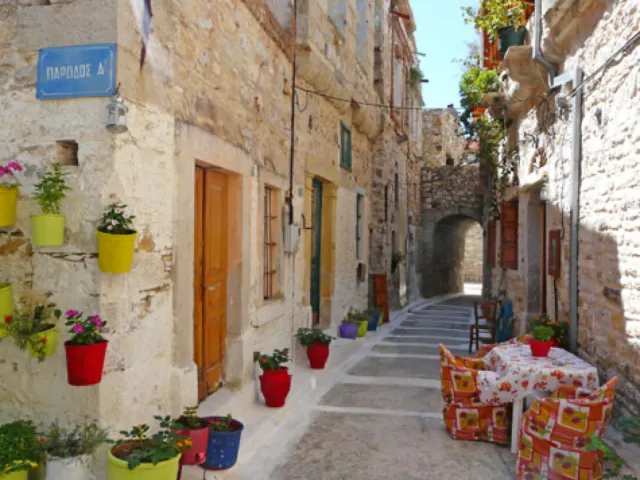
The museum occupies a medieval stone building. Before exploring its collection, discover how the village’s older homes fitted work and daily life into a compact space.
The older houses formed a dense structure rather than isolated buildings. Arches supported spaces above streets, while upper courtyards brought light and air into the homes. Look for the relationship between passages, walls and doorways: it reveals how everyday life fitted into a limited, protected space.
Continue into the village history →Source: Kalamoti local history archive ↗
A face above the entrance
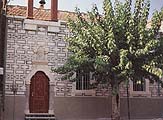
A carved face and ornamental relief above an arch. The archive does not name the maker or building.
Source & credit
Αρχείο kalamoti.net.gr · Μαρία & Αργυρώ Κανάριου · Original source
An architectural detail from the village archive, shown as context for the settlement; it is not an identification of this particular site.
The AIORA programme brings together objects shaped by the sea and nature, using its collection as a starting point for experiential learning. The organiser describes the museum’s home as a three-storey medieval stone building. Here, a village walk can turn into a conversation about how we observe, imagine and learn.
Call before visiting to arrange access and ask about activities, duration and admission. The Maps listing does not provide opening hours.
A different way to look at the sea
Two things to notice
Ask how natural forms become prompts for observation and learning. Leave time to discuss what you see, rather than treating it as a quick photo stop.
Notice how a historic house accommodates a contemporary educational use. Combine the visit with the lanes and churches nearby.
Can I drop in without arranging a visit?
Contact AIORA first. Ask about the programme for your group, opening, duration and cost; no regular visiting schedule is confirmed here.
Explore the village map
The place guides below are available without a map.
Aegean Sea Wonders Museum

What’s close by?
Approximate straight-line distances between pins.
Sea-shaped objects, imagination and a medieval stone house: a cultural stop on Pyrgou Street.
Read the place guide →What to notice here
Ask how natural forms become prompts for observation and learning. Leave time to discuss what you see, rather than treating it as a quick photo stop.
Keep exploring this subject
Pins are place references, not verified entrances or a route. Streets and buildings: OpenStreetMap. Selected listings checked on Google Maps; local access may differ. For a full loop, use the walking guide.
Follow a complete walking tour →All village place guides

Meet the sculptor · Michail Tombros
Look beneath the figure for the carved word ΔΟΞΑ (glory). Tombros first learned to work stone in his father’s marble workshop. By 1910 he had a workshop of his own in Athens. Here in Kalamoti his relief became the village’s memorial to its fallen. Artist biography · National Gallery ↗

Related history and places
How a village house made room for life
Look beyond the façade: upper courtyards, passages and the way neighbouring homes fit together.
→Angeliki Damala
Continue with a teacher’s story of learning, theatre and support for the community.
→Medieval lanes & Platsa
Return to the lanes and Platsa. Read the arches, doorways and shared walls with the story in mind.
→