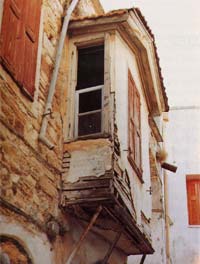
Projecting wooden bay
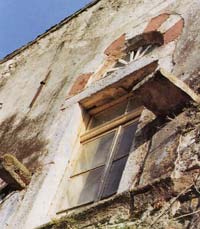
A timber bay projects above the lane. Its glazed sides bring another material and scale to the stone façade.
Source & permission
Αρχείο kalamoti.net.gr · Μαρία & Αργυρώ Κανάριου · Original album · Reproduced with permission
Architecture makes more sense when we see the life it held.
Discover Kalamoti through six illustrated chapters and 24 images from the older village website: connected houses, carved stone, household tools and people gathered at school and on the coast.
The old architecture account describes Kalamoti as a compact, enclosed settlement whose perimeter houses helped form a defensive edge. Space was precious: homes, churches and narrow lanes were fitted closely together, with few open communal areas. This helps explain why the village is best read as a connected structure rather than a collection of isolated houses.
Its architectural history distinguishes movement at three levels: along the streets, through the interiors and across adjoining roofs. Rooms above lanes and arches between buildings joined the fabric together. These are descriptions of a historic arrangement; they do not make private interiors or roofs part of a present-day walking route.
From a public lane, trace the arch from one wall to the other. Where does the street become covered?
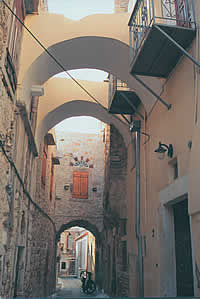
Repeated arches shape the view along a narrow street. Look at the spaces between them as well as the stone.
Αρχείο kalamoti.net.gr · Μαρία & Αργυρώ Κανάριου · Original album · Reproduced with permission
In the older house, the upper-level open space called xato or agerto organised circulation and brought light and air to surrounding rooms. The archive describes a stone stair leading up from the entrance, with straight, L-shaped or U-shaped layouts. The stair could be supported on vaults, linking structure with the use of the space beneath it.
The xato also gave access to the roof, known locally as the vota. It was not identical in every house: some examples were later covered and lit through raised openings. The vocabulary preserves a way of inhabiting the building, not simply a list of picturesque details.
Look for the relationship between entrance, stair and upper storey without entering private property.
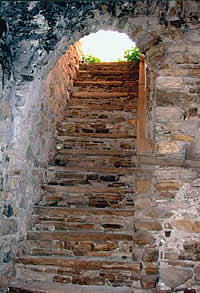
A narrow flight of worn steps rises beneath an opening. This image illustrates circulation, not a confirmed public route.
Αρχείο kalamoti.net.gr · Μαρία & Αργυρώ Κανάριου · Original album · Reproduced with permission
The archive describes arched lintels, carved stone frames and timber doors and shutters. Earlier combinations of brick and porous stone were followed by large alternating pieces of pale and red Thymiana stone, associated in the account with the influence of the mansions of Kampos. The façade therefore records choices and changes as well as defensive construction.
Windows widened towards the interior and could include built-in seats. Small stone projections outside supported boards for flowerpots. Projecting timber bays, called sachnista or kioski, are attributed by the archive to nineteenth-century craftsmen from Chios town. A single façade can hold several periods; its photograph alone cannot date each intervention.
Compare a plain opening with a carved one. Notice material, depth, colour and the join between timber and stone.
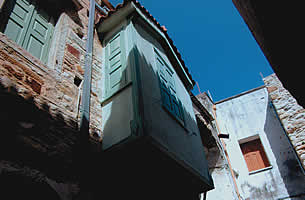
The underside and projecting sides of a wooden bay, photographed from the street.
Αρχείο kalamoti.net.gr · Μαρία & Αργυρώ Κανάριου · Original album · Reproduced with permission
The household account describes a home shaped by agricultural work. Storage, animals and processing of produce belonged close to domestic life. Bread-making, cheese-making and weaving required tools, room and repeated labour. Understanding these activities gives the ground floor, stair and upper rooms a practical meaning.
The account remembers three windmills serving the village, followed after 1950 by powered flour mills. At home, flour was sifted, sourdough prepared the evening before and dough kneaded in a wooden trough. A hand mill crushed grain for dishes such as chontros. The tools connect daily nourishment with the time and effort invested in each household.
Look at the scale of the tools. What space and physical effort would each task have required?
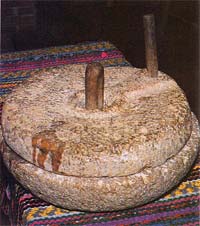
Two circular stones and a wooden handle: a household tool for crushing grain.
Αρχείο kalamoti.net.gr · Μαρία & Αργυρώ Κανάριου · Original album · Reproduced with permission
The cultural-tradition album follows cotton and wool through spinning and weaving. The warp, stimoni, held the lengthwise threads; the weft, fadi, crossed them in the shuttle. The names of the tools and fabrics make visible the knowledge needed to supply a household with clothing, towels, bedding and covers.
The archive distinguishes sturdy dimito cloth, finer apolyto and kordone used for blankets and bedcovers. It also describes agricultural work beyond mastic, including repeated preparation of tobacco fields. Kalamoti’s economic life was a combination of crops, animals and household production, with tasks changing through the year.
Compare the stripes, density and use of the displayed fabrics. A textile records work as well as decoration.
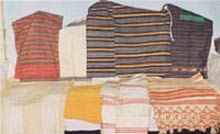
Striped woven textiles displayed in the tradition album. The archive describes several local types of weaving.
Αρχείο kalamoti.net.gr · Μαρία & Αργυρώ Κανάριου · Original album · Reproduced with permission
The older-photographs album groups school celebrations, parades and performances under the period 1955–1965. Its caption recalls a primary school with more than a hundred pupils. The pictures let us see groups, costumes and tables rather than only buildings and benefactors’ names.
Read these images beside the stories of Angeliki Damala and Georgios Kanarios. They offer context for the school’s cultural and communal role, but the archive does not identify either teacher in these particular frames. The bridal-dress photograph has a separate caption dating its festive occasion to 1935. These caption dates are retained as the archive’s attribution.
Notice how people are arranged in a group photograph. A name, programme or second print could help complete its caption.
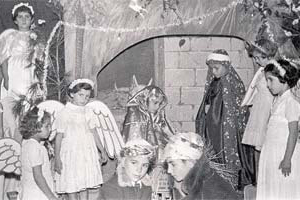
Children in costume in a school performance. The album groups this photograph with school life in 1955–1965; individual names are not supplied.
Αρχείο kalamoti.net.gr · Μαρία & Αργυρώ Κανάριου · Original album · Reproduced with permission
Open a term to connect it with a room, material or task described in the archive.
An upper-level open space bringing light, air and access to rooms and the roof.
The local term for the roof terrace in the archive’s architectural account.
An enclosed projecting timber bay above street level.
The lengthwise threads of a loom and the thread passed across them.
Two stone plates that crush grain as the upper stone turns.
Original small-format files, kept intact. Open an image for its full caption and use the arrows to move through the selected collection.
A timber bay projects above the lane. Its glazed sides bring another material and scale to the stone façade.
Αρχείο kalamoti.net.gr · Μαρία & Αργυρώ Κανάριου · Original album · Reproduced with permission
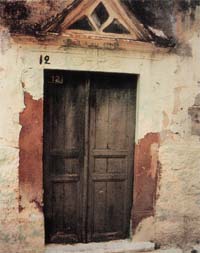
A wooden door, framed stonework and a triangular pediment. The photograph does not establish a building date.
Αρχείο kalamoti.net.gr · Μαρία & Αργυρώ Κανάριου · Original album · Reproduced with permission

A carved face and ornamental relief above an arch. The archive does not name the maker or building.
Αρχείο kalamoti.net.gr · Μαρία & Αργυρώ Κανάριου · Original album · Reproduced with permission
Alternating tones of dressed stone draw the eye to the opening and the relief above it.
Αρχείο kalamoti.net.gr · Μαρία & Αργυρώ Κανάριου · Original album · Reproduced with permission
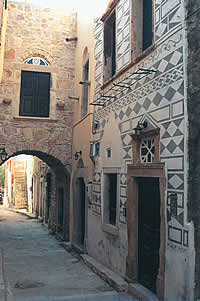
A decorated façade faces an arched passage. Notice how surface detail and shared street space meet.
Αρχείο kalamoti.net.gr · Μαρία & Αργυρώ Κανάριου · Original album · Reproduced with permission
A narrow flight of worn steps rises beneath an opening. This image illustrates circulation, not a confirmed public route.
Αρχείο kalamoti.net.gr · Μαρία & Αργυρώ Κανάριου · Original album · Reproduced with permission
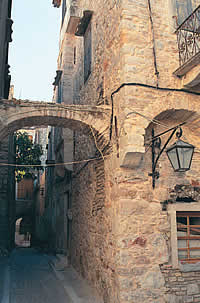
A stone arch spans the lane between neighbouring buildings.
Αρχείο kalamoti.net.gr · Μαρία & Αργυρώ Κανάριου · Original album · Reproduced with permission
Repeated arches shape the view along a narrow street. Look at the spaces between them as well as the stone.
Αρχείο kalamoti.net.gr · Μαρία & Αργυρώ Κανάριου · Original album · Reproduced with permission
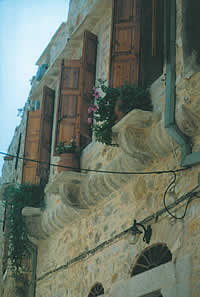
An exterior stair and metal railing beside an articulated stone façade.
Αρχείο kalamoti.net.gr · Μαρία & Αργυρώ Κανάριου · Original album · Reproduced with permission
The underside and projecting sides of a wooden bay, photographed from the street.
Αρχείο kalamoti.net.gr · Μαρία & Αργυρώ Κανάριου · Original album · Reproduced with permission
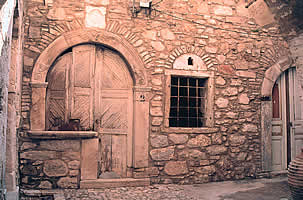
A broad wooden entrance, a barred window and a smaller doorway within one stone front.
Αρχείο kalamoti.net.gr · Μαρία & Αργυρώ Κανάριου · Original album · Reproduced with permission
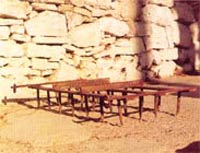
A metal harrow in the cultural-tradition album. Its teeth broke up the soil after ploughing.
Αρχείο kalamoti.net.gr · Μαρία & Αργυρώ Κανάριου · Original album · Reproduced with permission
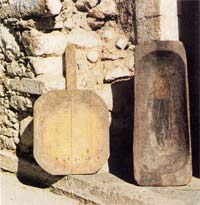
A kneading trough and wooden board in the archive’s account of bread-making.
Αρχείο kalamoti.net.gr · Μαρία & Αργυρώ Κανάριου · Original album · Reproduced with permission
Two circular stones and a wooden handle: a household tool for crushing grain.
Αρχείο kalamoti.net.gr · Μαρία & Αργυρώ Κανάριου · Original album · Reproduced with permission
Striped woven textiles displayed in the tradition album. The archive describes several local types of weaving.
Αρχείο kalamoti.net.gr · Μαρία & Αργυρώ Κανάριου · Original album · Reproduced with permission
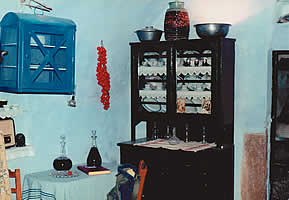
A cupboard, vessels, textiles and a shuttered window. The archive gives no date or household name.
Αρχείο kalamoti.net.gr · Μαρία & Αργυρώ Κανάριου · Original album · Reproduced with permission
Children in costume in a school performance. The album groups this photograph with school life in 1955–1965; individual names are not supplied.
Αρχείο kalamoti.net.gr · Μαρία & Αργυρώ Κανάριου · Original album · Reproduced with permission
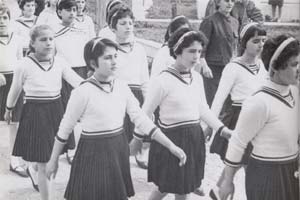
Pupils walking in formation, from the school-life group dated 1955–1965 by the archive.
Αρχείο kalamoti.net.gr · Μαρία & Αργυρώ Κανάριου · Original album · Reproduced with permission
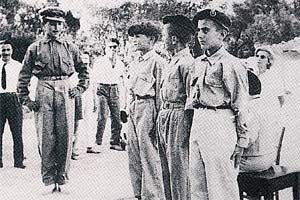
Pupils outdoors in a procession. The album supplies a period, 1955–1965, rather than an exact day.
Αρχείο kalamoti.net.gr · Μαρία & Αργυρώ Κανάριου · Original album · Reproduced with permission
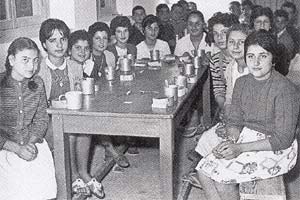
Children and adults around long tables. The archive includes the image in its 1955–1965 school-life collection. No individual is identified here.
Αρχείο kalamoti.net.gr · Μαρία & Αργυρώ Κανάριου · Original album · Reproduced with permission
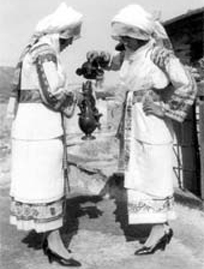
The original caption identifies women of Kalamoti wearing bridal dress at a festive occasion in 1935.
Αρχείο kalamoti.net.gr · Μαρία & Αργυρώ Κανάριου · Original album · Reproduced with permission
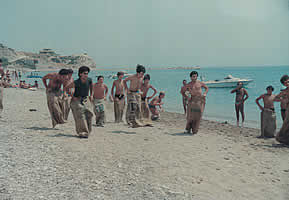
A group on a beach, preserved in the old-photographs album. The original page supplies no date or names.
Αρχείο kalamoti.net.gr · Μαρία & Αργυρώ Κανάριου · Original album · Reproduced with permission
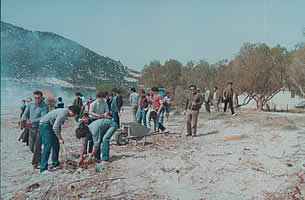
People gathered near trees on the shore. The occasion and date remain undocumented in the album.
Αρχείο kalamoti.net.gr · Μαρία & Αργυρώ Κανάριου · Original album · Reproduced with permission
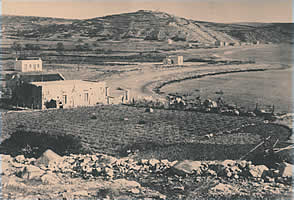
Fields, scattered buildings and the curve of the shoreline in an undated archive view.
Αρχείο kalamoti.net.gr · Μαρία & Αργυρώ Κανάριου · Original album · Reproduced with permission
The stones still host new experiences. Georgios Damalas’s public account records the Chios Music Festival’s walking performance on 28 and 30 July 2025, with photographs and video. The contemporary photography project featured in the journal offers another way to look at the settlement and its future.
The text has been adapted and translated from kalamoti.net.gr. Its owner authorised republication of the archive text and photographs for this guide. The older site credits Maria and Argyro Kanariou; individual photographers are not named on these album pages. Original credits are retained. This permission is not a Creative Commons licence for onward reuse.
Dates follow the original captions. Undated images stay undated, and people are not identified from appearance alone. The surviving files have not been enlarged with invented detail. Facebook and newspaper media remain with their publishers.
Add a name, date or your own photograph ↗