Choose a subject and follow a question into the story. Make a guess, or reveal the account straight away. Each source opens a different window onto Kalamoti.
A stone alley with an arch and flower pots in Kalamoti village, Chios Ailinaleixo · CC BY-SA 3.0 · Photo source
01 / Stone
The village has more than one age
An arch draws your eye upwards. A doorway brings it back to street level. Before calling everything medieval, pause over the differences.
How can you read the age of a street?
Reveal the story
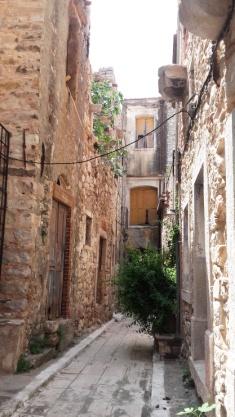
Look for layers, not a single date. The official Chios guide describes how the 1881 earthquake and later rebuilding changed Kalamoti. Doors and windows can reflect newer architectural influences within an older settlement. A façade alone is not enough to date a house.
Stone house fronts, doorways and plants along a lane in Kalamoti S. Kossieris, O. Kourounioti, P. Agrafiotis & A. Georgopoulos · NTUA · CC BY 4.0 · Photo source
02 / Water
A household’s day, measured in water
Think of cooking, washing and caring for a household. Then imagine planning those tasks around a journey for water.
What did communal taps change first?
Reveal the story
Evangelia Misailidou recalls women waiting with water jars at communal taps. Connections inside homes came later. Her 2020 testimony shows how a public work changed everyday effort, one household at a time.
Read the water-supply biography before your walk. Imagine the route between a home and a shared water point; the photograph illustrates a village lane, not an identified former tap.
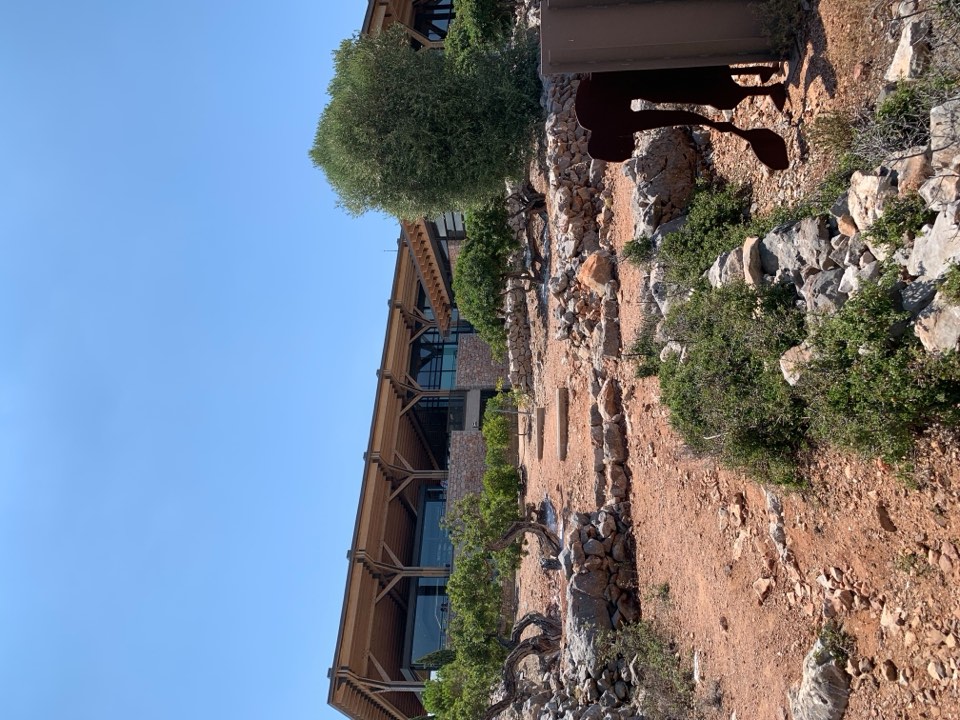
The Chios Mastic Museum building and outdoor mastic garden Robot8A · CC BY-SA 4.0 · Photo source
03 / Mastic
Beyond the work beneath a tree
A harvest belongs to a grower, but its journey reaches beyond the field. Follow the thread from individual work to collective organisation.
What did the cooperative organisation bring together?
Reveal the story
The growers’ association dates the cooperatives and their union to 1938, with operations beginning in 1939. Local cooperatives collected the crop; the union handled further processing and marketing. This is a regional story that helps explain Kalamoti’s place in a wider working landscape.
At the Mastic Museum, follow one question: what happens between the tree and the finished product? Back in Kalamoti, read about the growers’ assemblies.
A stone alley with an arch and flower pots in Kalamoti village, Chios Ailinaleixo · CC BY-SA 3.0 · Photo source
04 / Learning
A school with a wider horizon
A benefactor’s name is a beginning. To understand a gift, follow what it made possible for the people around it.
Who travelled to the school in this recollection?
Reveal the story
Misailidou remembers pupils coming from neighbouring villages on foot or by donkey. It is a personal recollection, not information about today’s school transport.
Continue with the benefactors’ biographies and today’s associations. Ask what a shared project enables: learning, care, a meeting place or help in everyday life.
Kalamoti’s fertile surroundings, its place in the mastic landscape and its former administrative role help explain its importance within southern Chios. The official Chios guide connects the plain and nearby Apolichnon castle with Genoese defensive planning. Calling it a heart of the Mastichochoria describes these connections: fields, settlement and the organisation of a wider region.
Begin in the lanes, then visit the Mastic Museum to connect the settlement with its landscape.
1881 & AFTER
A village that changed its shape
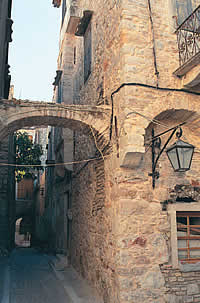
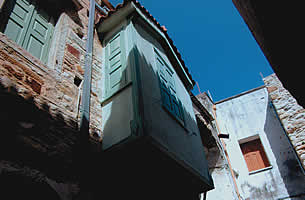
The 1881 earthquake and subsequent rebuilding changed Kalamoti. Chios’s official guide identifies later influences from Chios Town and Kampos in doors and windows. Look at the village as a succession of building periods: the medieval layout survives alongside later choices, repairs and additions.
A stone arch spans the lane between neighbouring buildings.
Source & credit
Αρχείο kalamoti.net.gr · Μαρία & Αργυρώ Κανάριου · Original source
TAKE IT INTO YOUR WALK
Notice the different openings and stonework; a façade alone cannot reliably date a house.
EVERYDAY MEMORY
Neighbours, shops and water
In her 2020 Istorima interview, Evangelia Misailidou remembers a village of shops and evening gatherings, and women carrying water from communal taps. Her account brings the infrastructure in the benefactors’ biographies down to the scale of a household. This is a resident’s recollection, not a present-day inventory of services.
Read the water-supply story of Mikes Grigoriadis alongside the oral testimony.
1938–1939
From harvest to collective strength
The growers’ union dates the creation of the compulsory cooperatives and their union to 1938, with operations beginning in 1939. Growers’ harvests could then be gathered, processed and marketed through a common organisation. This wider Mastichochoria story helps explain why the mastic year involves more than work beneath a tree.
Pair the museum with the village chapter on the growers’ assemblies in Kalamoti.
A REGIONAL ROLE · 1941
Six villages, a shared office
The Mingei research project records a regional cooperative accounting office established in Kalamoti in August 1941. It served Kalamoti, Mesta, Olympoi, Pyrgi, Armolia and Patrika. War disrupted its operation. This practical administrative role adds another dimension to the village’s place in the mastic economy: organising records and supporting cooperation across neighbouring settlements.
On a journey through these villages, compare their individual architecture while remembering the work that connected them.
1947–1957
Building a shared future
The growers’ association’s village history highlights 1947–1957 as a period of major works supported by benefactors. It also records agriculture, including mastic and olive oil, and the growing turn towards education after 1950. Schooling and public improvements belong beside the medieval lanes in any account of what made Kalamoti important.
Follow the biographies to discover the people behind schools, water and care.
AN ARCHIVAL DETAIL · 1930
Learning to look closely
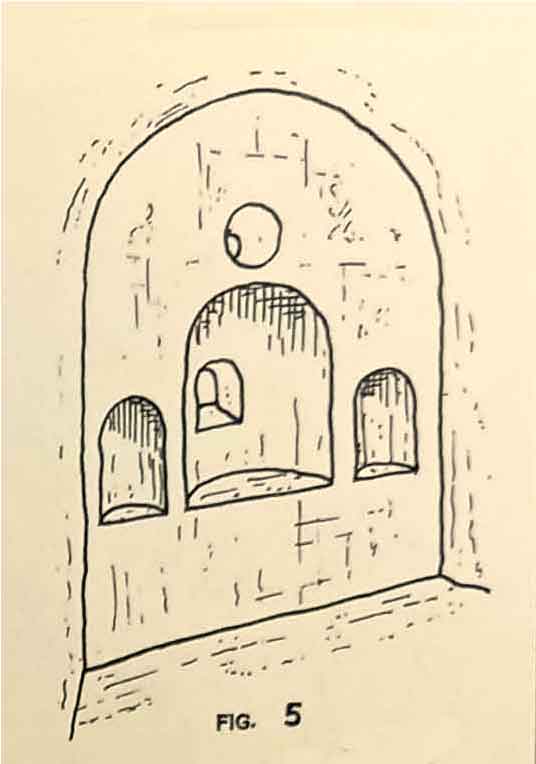
This drawing of Agia Marina’s sanctuary in Kalamoti is catalogued on Wikimedia Commons as a Dimitris Pikionis illustration from The Architecture of Chios (1930). Its careful recording of openings and curves offers another way into village architecture. It documents a historical view, not the building’s present condition or visitor access.
Compare a documented detail with what you can see from public lanes, without entering private spaces.
LIVING COMMUNITY · 2026
The next generation is here
Kalamoti Primary School’s 2026 announcements describe reading projects and children making their own storytelling boxes. Such everyday activity belongs in the village’s story just as much as monuments do. For families considering a move, the school’s own contact page is the place to discuss enrolment and current arrangements.
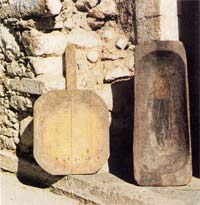
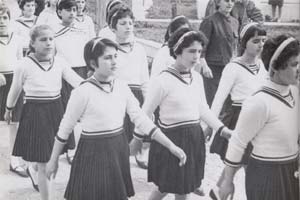
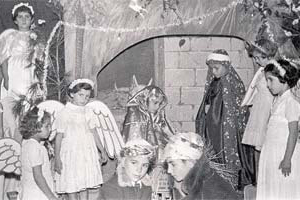
Archive photographs connect the architecture with the work and celebrations of village life. Explore the xato, carved openings, household crafts and school photographs from 1955–1965.