A school open to village life
The teacher who brought learning, theatre and community support together.
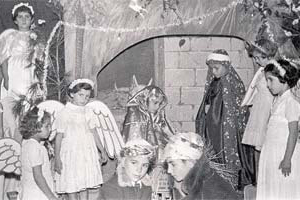
Photo source & credit
Αρχείο kalamoti.net.gr · Μαρία & Αργυρώ Κανάριου · Catalogue / original
“a workshop of intellectual and cultural creation”
The life behind the name
Born in Kalamoti, Angeliki Damala returned in 1936 to teach at its primary school. Her local biography describes an educator whose work reached beyond the classroom, into theatre, cultural events and community life.
In 1937 she helped establish the village’s women’s charitable association. She later served on the community council from 1982 to 1986. Her story connects education with the everyday needs of a village.
Before her return to Kalamoti, Damala taught on Psara. The village biography places that appointment in 1930. Her later work in Kalamoti brought her into collaboration with fellow teacher Georgios Kanarios.
Her work took her away from the village again in 1966, when she moved to Athens. The later council service is a useful final chapter: her public contribution extended well beyond the years by which former pupils would have known her as their teacher.
Timeline
- 1930Teaching on Psara
- 1936Return to Kalamoti’s school
- 1966Teaching career moves to Athens
- 1982–1986Community council service
- 2001Dies in July
The journey before the return
Damala’s own education took her beyond Chios: secondary school on Corfu, entry to the teacher-training school on Lesvos, and a teaching qualification completed in Athens. Her first appointment on Psara preceded her return to Kalamoti. That journey belongs in the portrait. The teacher who helped make the village school a cultural centre had herself moved between islands and the capital to train.
A performance changes the relationship between a school and its neighbours. Families become an audience; children have something to prepare together; the room has a life after lessons finish. Seen beside her charitable work, this makes the school a place of participation. Her contribution is worth remembering through the opportunities it created for others to take part, as well as through the positions she held.
A song carried into another generation
The report of the 6 August 2014 benefactors’ ceremony says the Progressive Union choir performed “Πέτα, πέτα”, crediting Angeliki M. Damala with its words and music. This later public performance gives a concrete trace of her cultural work surviving beyond her classroom years.
Explore the illustrated report ↗The teacher in the local archive
Open the original Greek biography, including its portrait, in the guide’s reading room.
Open original in the guide ↗Greek-language source. The publisher’s page loads only after you choose to open it.What it means to open a school to village life
A classroom, a rehearsal and a charitable association ask different things of a teacher. Lessons need preparation; a performance needs people willing to take part; support for a household needs trust. Reading these activities together makes Damala’s contribution easier to understand. Education here reaches into the relationships that let a community learn, meet and organise help. The stage deserves a place beside the school desk in her story.
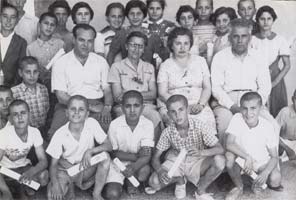
Photo source & credit
Αρχείο kalamoti.net.gr · Μαρία & Αργυρώ Κανάριου · Catalogue / original
A contribution with many hands
Schoolchildren and their families, fellow teachers, amateur performers and volunteers all belong around this portrait. Their names may be less visible in a short biography, but a lesson, performance or collection of help depends on them. Follow the associations guide to discover the village’s organised community life today, and look for the people who make its activities possible.
Why does theatre belong in a teacher’s biography?
Her local biography describes performances and educational events alongside teaching. They show the school’s role in bringing people together, beyond its classroom timetable.
The village around the school
Walk the public lanes and notice how quickly a doorway opens onto shared space. Read the associations guide to connect the cultural work in this portrait with organisations active in village life.
Use the memorial beside the primary school as a point of orientation for Angeliki Damala’s teaching and community work. This is a connection with the school; the memorial is not dedicated to her.
Read the place guide →Locate it on the village map →Sources
The life and dates above follow the published accounts below. The reflections on their meaning are our editorial reading. Reviewed 3 November 2026.
About the evidence
The biography dates her involvement in founding the Philoptochos to 1937. This is the source’s chronology, not an independently checked founding charter. No classroom dialogue or private thoughts have been reconstructed.
What does your family remember?
Do you have a school programme, class photograph or memory of a performance? A date, names and the photographer’s permission would help give it context.
Share a memory or photograph ↗Contributions are reviewed before publication.