Light for the village. Room to learn.
An emigrant’s return became part of the story of schooling and electricity.
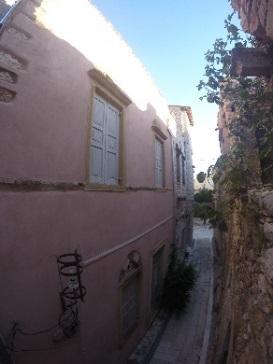
Photo credit & licence
S. Kossieris, O. Kourounioti, P. Agrafiotis & A. Georgopoulos · NTUA · Catalogue / original · CC BY 4.0
“working hard in his own restaurant”
The life behind the name
Konstantinos Vamvakas was born in Kalamoti in 1880. Leaving young to find work, he later settled in the United States and ran a restaurant. Distance did not end his connection with home.
The biographical account in Mastichochorousika Nea connects his 1953 visit with funding a second wing at the secondary school and the village’s electricity supply. His gifts supported infrastructure that an entire community could share.
The account presents two priorities together: more space for secondary education and an electricity supply. Reading them as a pair reveals the breadth of the needs that a returning emigrant chose to support.
The remembrance also brought village organisations together. A 2013 report names the Philoptochos, the mastic producers’ cooperative and the church of Agia Paraskevi among supporters of his commemorative bust. A book about the secondary school helped fund it: the history of education became a means of preserving the memory of someone who had supported it.
A life and its legacy
- 1880Born in Kalamoti
- 1905Moves to the United States
- 1953School wing and electricity gifts
- 1968Dies in the United States
- 2013Community account of the bust project
A route through work and migration
The biography places Vamvakas in Batumi at the age of thirteen, employed by the Ralli brothers. He moved to the United States in 1905, briefly returned to Chios in 1912 and later worked in his own restaurant in Pennsylvania. His 1953 visit was part of a much longer journey. The story of the school wing begins with decades of work away from the village.
That distance is important. A village can be shaped by people who no longer live there every day, while the usefulness of a gift depends on those who do. The school wing links an emigrant’s resources with teachers and pupils; the electricity project links the act of giving with a shared network. Both ask us to remember a relationship between people, rather than to stop at the donor’s name on a commemorative monument.
How a village remembers a gift
A report published on 7 August 2014 documents the unveiling of Vamvakas’s bust and an event honouring Loukas and Kyriaki Ktistakis. Its photographs record later public remembrance; they are not images of the original 1953 projects.
Read the documented account ↗The village remembers, in photographs
Explore the illustrated report of the August 2014 ceremony: the unveiling of Vamvakas’s bust, the speakers and the gathering around it. The original photographs remain with their publisher.
Open original in the guide ↗Greek-language source. The publisher’s page loads only after you choose to open it.What a new wing and a light can change
It is easy to walk past a school building without thinking about the decisions that made room for it. An extra wing represents space set aside for learning. Electricity changes the possibilities of an evening: reading, working or gathering after daylight. These are ways to understand the purpose of the gifts, rather than evidence that every household gained the same opportunities at the same moment. Public improvements and personal experience do not move at identical speeds.
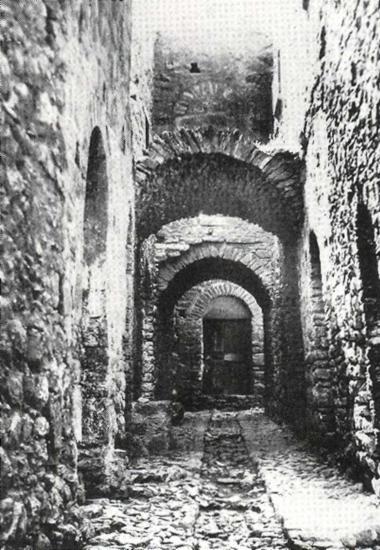
Photo credit & licence
Mingei project / ICS-FORTH · via SearchCulture.gr · Catalogue / original · CC BY-SA 4.0
How a village remembers a benefactor
A later local report describes the community effort behind Vamvakas’s commemorative bust, including proceeds from a book about the secondary school. Remembering the benefactor became another shared undertaking. For a visitor, this adds a second question to the story: how is gratitude passed on? Through a name, a monument, a book—and through explaining what the original contribution was intended to make possible.
Were the school wing and electricity separate gifts?
The biographical account presents two projects associated with his 1953 visit. They address different needs: space for education and a shared electricity supply.
Read the school’s wider setting
Use the school-area memorial guide as a nearby public-space stop, then read the shared-future heritage chapter. This is a contextual visit, not a claim that the memorial itself was Vamvakas’s gift.
Read the evidence, follow the memory
The life and dates above follow the published accounts below. The reflections on their meaning are our editorial reading. Reviewed 3 November 2026.
About the evidence
The biography associates the gifts with 1953. We do not infer a household-by-household electrification date. The later commemorative report concerns how the community honoured him, rather than the construction record of the original works.
What does your family remember?
Do you have a school photograph or a family recollection of electricity arriving? Tell us whether it is a firsthand memory and how you date it.
Share a memory or photograph ↗Contributions are reviewed before publication.