A village cared for, quietly
From Kalamoti’s post office to small gestures on the Komi shore.
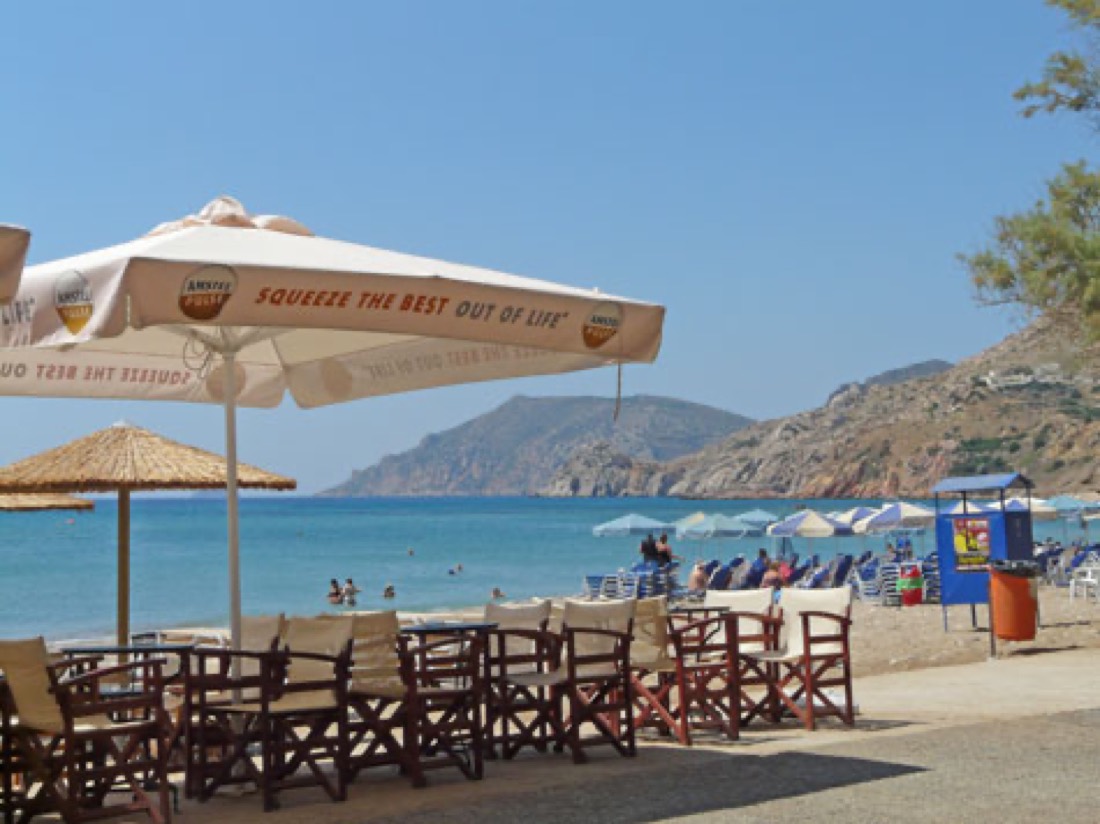
Photo credit & licence
Ailinaleixo · Catalogue / original · CC BY-SA 3.0

“holding his little walking stick”
The life behind the name
Born on Chios in 1905, Georgios Tsampas worked at Kalamoti’s post office. His local biography also records his service as treasurer of the village secondary school.
The account preserves a modest scene from Komi: in later life, he walked with his cane and picked litter from the beach. It is a remembered gesture of everyday care, preserved in the village’s account of his life.
The archive also recalls a brief move to direct Mytilene’s post office in 1962, followed by his return to Kalamoti. It presents his attachment to the village through work, family and the shore at Komi.
The biography records his marriage to Chryso Andrioti in 1930 and remembers his support for the Friends of Komi. Family life, postal work, the school and the coast form the different settings of his portrait. The account gives local history room for a person remembered through steady participation.
A life and its legacy
- 1905Born on Chios
- 1922Smyrna’s destruction redirects his studies
- 1930Marriage and a life in Kalamoti
- 1962Brief appointment on Lesvos; return home
A life redirected by upheaval
The local account places Tsampas’s early ambitions in Athens, where he entered law school. The destruction of Smyrna disrupted his father’s business and the family’s finances. He turned to postal training and employment, later taking the Kalamoti appointment after naval service. The familiar village postman’s life therefore begins with an interrupted course of study and a new profession.
This background changes how we read his school service. The biography remembers a man whose own studies had been disrupted helping the next generation through his work as school treasurer. It does not tell us his private motives. It does let us place education, livelihood and commitment to a village within the same life, instead of treating the beach recollection as the whole story.
The post office in wartime
The village account also credits Tsampas with helping people from nearby villages leave for the Middle East during the Occupation. It does not identify individual journeys or dates. This remains an attributed account, opening a question for further archival research.
Read the documented account ↗Read the remembered life
The local account preserves the connection between postal work, school service and Komi. Read it in its original Greek.
Open original in the guide ↗Greek-language source. The publisher’s page loads only after you choose to open it.Why the small gesture belongs in the history
The beach scene is easy to overlook beside accounts of large donations. Yet it offers a different measure of belonging: attention to a place on an ordinary day. A clean shore benefits people who may never know who cared for it. This is why a remembered walk with a cane can carry weight in a village portrait. It makes public responsibility visible at the scale of one person’s actions.
Photo credit & licence
S. Kossieris, O. Kourounioti, P. Agrafiotis & A. Georgopoulos · NTUA · Catalogue / original · CC BY 4.0
Read the shore as a shared place
When visiting Komi, give some attention to what sits outside the holiday photograph: the public passage, the sand beside a café, the space another visitor will use after you. The picture here shows the coast, not Tsampas or a documented clean-up. His story is an invitation to notice the work of care without turning an affectionate recollection into a claim about how every resident lived.
What connects the post office, school and beach?
They are three settings of the same recorded life: paid work, service to education and voluntary care for a shared place. The biography gives each a place in the village’s memory.
A slower look at Komi
Stand back from the waterline and look at the space shared by residents, visitors and businesses. Tsampas’s story offers a reason to value the public shore throughout the year.
Read the evidence, follow the memory
The life and dates above follow the published accounts below. The reflections on their meaning are our editorial reading. Reviewed 3 November 2026.
About the evidence
The beach scene is a recollection in the local biography. Its date is not established. Only a birth year is displayed because the source does not supply an explicit death year; we have not calculated one from his reported age.
What does your family remember?
Do you remember the post office or an everyday act of care at Komi? Tell us what you witnessed yourself and what was passed down to you.
Share a memory or photograph ↗Contributions are reviewed before publication.