Far away, still connected
A journey to America that became a lasting contribution at home.
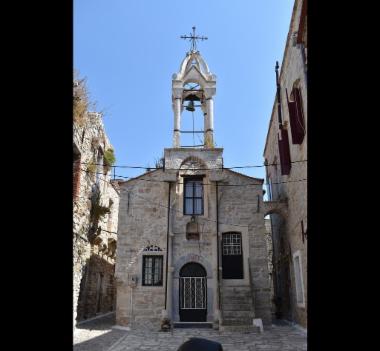
Photo credit & licence
Mingei project · ICS-FORTH (photographer not named in catalogue) · Catalogue / original · CC BY-SA 4.0
“seeking solutions together”
The life behind the name
Konstantinos Kokkalias was born in Kalamoti and left in 1955. After working in merchant shipping, he reached America in 1958 and later established a business.
His local biography records practical gifts to his birthplace: audiovisual equipment for the cultural centre in 1984, a refuse truck in 1987 and paving outside Agia Paraskevi in 1988. His connection with home continued through spaces and services shared by the village.
His biography traces a working life through painting buildings and the vending-machine business before establishing his own enterprise. It gives the gifts to Kalamoti a material background: employment, business-building and a continuing relationship with home.
The archive dates his start as an employee in the vending-machine trade to 1960, a partnership to 1963 and his own enterprise to 1966. This sequence gives the story a gradual pace: the later benefactor first appears as a worker learning a business and finding his place abroad.
A life and its legacy
- 1955Leaves Kalamoti
- 1958Reaches America
- 1966Establishes his own business
- 1984Equipment for the cultural centre
- 1987Refuse-collection vehicle for the community
- 1988Paving outside Agia Paraskevi
Returning through conversation and print
The archive remembers summer visits to Komi and conversations with fellow villagers about Kalamoti’s needs. It also credits Kokkalias with meeting half the publication costs of the village-history book from which the account was drawn. The gift was therefore cultural as well as practical: helping a place publish its history belongs beside equipment, paving and everyday services.
These details make the relationship with home more tangible. A donation begins with a need that someone has noticed and explained. A summer conversation can connect a resident’s experience with the resources of someone living elsewhere. The book adds another kind of continuity: later generations can encounter the village’s history even when the people who remembered its earlier life are no longer there to tell it.
Beyond the paving
The biography records another 1988 gift: purchasing a ground-floor building north of Agia Paraskevi for church ceremonial needs. This adds a less visible space to the story of the square. Its precise entrance and present use have not been verified for this guide.
Read the documented account ↗The original account of his gifts
Follow the dated contributions and the account of his continuing connection with Kalamoti.
Open original in the guide ↗Greek-language source. The publisher’s page loads only after you choose to open it.The practical side of giving
A camera, a refuse truck and paving serve very different parts of public life. One helps a community record and share; another supports a regular service; the third concerns the ground beneath a gathering. Together, these gifts invite us to look beyond a donor’s name and ask what a contribution enables people to do. They also point to the work that follows a gift: operating equipment, arranging its use and maintaining it.
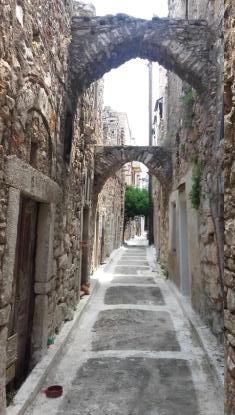
Photo credit & licence
S. Kossieris, O. Kourounioti, P. Agrafiotis & A. Georgopoulos · NTUA · Catalogue / original · CC BY 4.0
A square is part of the story
Agia Paraskevi is included in the five-church village walk. Read Kokkalias’s story before you arrive, then look at how people move between the church, lanes and centre. The archive connects his donation with the square’s paving; it does not establish that every surface visible today is the original work. The photograph illustrates village architecture, rather than certifying the precise donation site.
Why include a book among public gifts?
It makes local knowledge available beyond the people who hold it in memory. In this case the source credits Kokkalias with helping finance the publication of the village’s history.
The square outside Agia Paraskevi
Look at the relationship between the church entrance, paving and surrounding lanes. The documented 1988 gift connects this shared space with the biography; today’s surfaces may include later work.
Read the evidence, follow the memory
The life and dates above follow the published accounts below. The reflections on their meaning are our editorial reading. Reviewed 3 November 2026.
About the evidence
The source is a commemorative biography and includes language written during his lifetime, although its heading gives 1929–1991. We retain dated events and avoid presenting its “today” as a current statement.
What does your family remember?
Do you have a dated photograph of the cultural centre or square, or remember the equipment arriving? A clear caption could help connect a donation to its use.
Share a memory or photograph ↗Contributions are reviewed before publication.