A gift carried home in water jugs
The memory of water reveals the value of shared infrastructure.
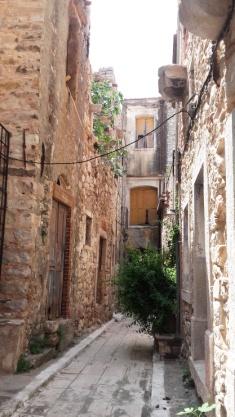
Photo source & credit
S. Kossieris, O. Kourounioti, P. Agrafiotis & A. Georgopoulos · NTUA · Catalogue / original · CC BY 4.0
“women holding their water jugs”
The life behind the name
Born in Kalamoti, Mikes Grigoriadis built his career in the pharmaceutical trade in Athens. The village archive records his philanthropic activity.
In a 2020 Istorima interview, Evangelia Misailidou recounts his funding of the village water supply and public taps. She remembers women waiting with water jugs. This oral testimony gives the gift a human scale: the daily routines of households, and an essential resource made easier to reach.
The local biography traces Grigoriadis’s working life to an Athens pharmaceutical warehouse, which he bought in 1927. For the village water story, a second kind of source matters: a resident’s recorded recollection.
Misailidou describes an intermediate stage between fetching water from farther away and having it inside the home: a small number of public taps, with women carrying jugs. Later household connections belong to the same recollection. The distinction matters because a village water supply and a tap in every house are different stages of change.
A life and its legacy
- 1899Born in Kalamoti
- 1927Purchases the Athens warehouse
- 1973Dies in Athens
- 24.08.2020Misailidou’s recorded recollection
Before the gift, a working life in Athens
Grigoriadis reached Athens at fifteen and began as an employee at the Psaras pharmaceutical warehouse. The local biography describes his rise to its management despite a very short formal education. It also records philanthropy beyond Kalamoti, including support for an orphanage in Chalkida. The village water story is one part of that wider public life.
Listen to the water recollection with attention to the containers and the people carrying them. Infrastructure is often remembered as a date or a donor’s name. Here it is also a household task: reaching a source, waiting, filling a jug and taking it home. The account preserves the work that remained even after water reached the village. This makes it valuable for understanding how large improvements entered daily life in stages.
Two sources, two kinds of evidence
The village biography dates his purchase of the pharmaceutical warehouse to 1927. Misailidou’s recorded testimony describes water collection in Kalamoti. The business chronology and the household memory answer different questions; neither should silently replace the other.
Read the documented account ↗Listen to the village remembering
The Greek recording and transcript are available through Istorima. Open them inside the guide; playback starts only when you choose it.
Open original in the guide ↗Greek-language source. The publisher’s page loads only after you choose to open it.Water, measured in everyday effort
A public tap belongs to the history of a place through the work it changes. Think of water as something that must be reached, carried and used throughout a day. Misailidou’s recollection brings the household into a story that could otherwise remain a donor’s biography. It also keeps women’s work in view. We cannot calculate time saved or identify each tap from this testimony alone, but we can recognise why access to water deserves a place in the village’s social history.
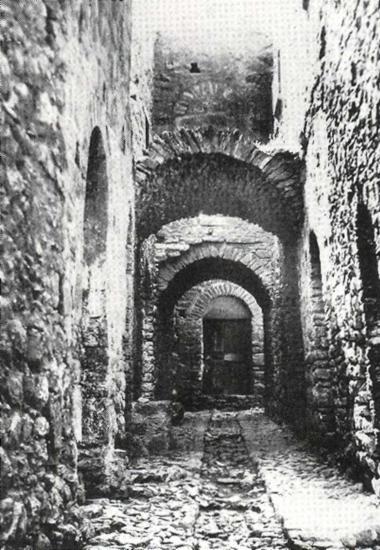
Photo source & credit
Mingei project / ICS-FORTH · via SearchCulture.gr · Catalogue / original · CC BY-SA 4.0
Hear the person who remembers
The interview was recorded by Angeliki Agalianou for Istorima on 24 August 2020. Open the original recording and transcript below to encounter the recollection in its own setting. A spoken memory has a narrator, a moment of recording and a point of view. It adds lived experience to the biography; it should not be mistaken for an engineering plan or a complete chronology of the water network.
Did public taps mean running water in every home?
No. Misailidou remembers public collection points and later household connections as different stages. The story should preserve that distinction.
Lanes at the scale of a household
Walk through the village with the water-carrying recollection in mind. Observe the distances and thresholds of the lanes. No precise historic tap locations are established by this guide.
The fountain is a starting point for Mikes Grigoriadis’s story and memories of carrying water home. The testimony concerns the village water supply, not the construction date of this particular fountain.
Read the place guide →Locate it on the village map →Read the evidence, follow the memory
The life and dates above follow the published accounts below. The reflections on their meaning are our editorial reading. Reviewed 3 November 2026.
About the evidence
The water-supply account is attributed to Evangelia Misailidou’s interview. The photographs show village streets, not verified fountains or Grigoriadis himself. No interview audio has been copied or generated.
What does your family remember?
Can you identify an old public tap in a family photograph? A location, approximate date and account of who used it would help document everyday life.
Share a memory or photograph ↗Contributions are reviewed before publication.