Beyond the classroom
A teacher whose work connected education with collective effort.
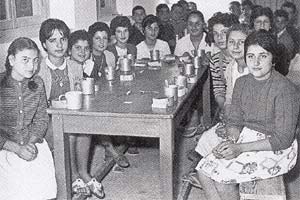
Photo source & credit
Αρχείο kalamoti.net.gr · Μαρία & Αργυρώ Κανάριου · Catalogue / original
“founded a library in the church hall”
The life behind the name
Georgios Kanarios taught in Kalamoti from 1938 to 1963. His biography in the village archive describes collaborative efforts to provide school meals during the Occupation and support the community after the war.
In 1958–1959, as president of the Progressive Union, he established a library in a church hall. Elected community president in 1982, he continued a public life rooted in education and collective work.
Kanarios’s biography places the school meals within a partnership: fellow educators helped organise them and Mikes Grigoriadis provided financial support. It also describes adapting school rooms for performances in 1938.
The 1938 school alterations included a stage, screen and seating. In the account of wartime meals, Angeliki Damala and Konstantinos Epitropakis appear alongside Kanarios. These details make the collaboration concrete: rooms could serve more than one purpose, and the school’s work brought different people into a common effort.
A life and its legacy
- 1931–1933Agricultural training in Thessaloniki
- 1938–1963Teaching in Kalamoti
- 1958–1959A library in a church hall
- 1982Elected community president
- 1999Dies on 10 September
The work around the school meal
A later local recollection, published in September 2020, describes the school meals of the 1950s and 1960s. Food was prepared in a kitchen north of the school and served downstairs at tables with benches. Teachers supervised; Maria Tzioti is remembered as a cook and server during part of this period. The account recalls milk, cheese and butter. These are memories of the later meals, not a reconstruction of the Occupation-era service.
Putting a cook’s name beside the headteacher’s changes the scale of the story. Support depended on people preparing, serving, supervising and funding it. Kanarios’s role belongs within that network. The same approach helps us read the library: furniture and books made a beginning, but a library becomes part of village life through the people who open it, care for it and use it.
The network across the Atlantic
His biography names Giangos and Kostas Parthenidis and Stelios Triantafyllos in New York in the postwar relief effort. Clothing, footwear and stationery reached Kalamoti. Naming these collaborators helps recover the network behind a contribution often remembered through one public figure.
Read the documented account ↗Photographs and memories of school meals
Explore the illustrated 2020 account in its original setting. Its photographs remain with the publisher.
Open original in the guide ↗Greek-language source. The publisher’s page loads only after you choose to open it.Teaching, cultivation and cooperation
Kanarios also trained in agriculture in Thessaloniki in 1931–1933. His local biography connects him with the organisation of mastic producers and tree planting, including at Komi. That part of the portrait matters in a farming village. Education could reach beyond school subjects into cultivation and collective organisation. Read the village’s mastic-cooperation chapter alongside this life to see why teachers, growers and associations belong in the same wider history.
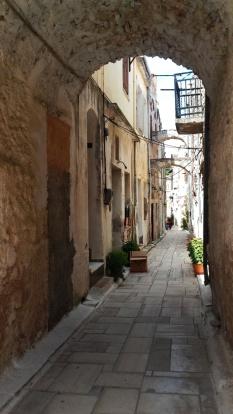
Photo source & credit
S. Kossieris, O. Kourounioti, P. Agrafiotis & A. Georgopoulos · NTUA · Catalogue / original · CC BY 4.0
Follow the connections between lives
Read this portrait alongside Damala’s and Grigoriadis’s. The same village appears from three viewpoints: teaching, organising and funding. Those connections matter more than a competition over who contributed most. They help a visitor understand why the history of a school can also be the history of food, cultural life and collective responsibility. The archival lane photograph provides period context; it does not show the school or the people involved.
Whose work can disappear from a benefactor’s story?
The daily work of cooks, teachers, organisers and volunteers. The later meal recollection helps restore one of those names and the practical setting of the service.
The school area and its public memory
The memorial guide is a nearby starting point for reading the school area. Remain in public spaces and respect school access; the buildings are part of everyday village life.
Read the evidence, follow the memory
The life and dates above follow the published accounts below. The reflections on their meaning are our editorial reading. Reviewed 3 November 2026.
About the evidence
The relationships described here come from the village biography. The practical explanation of how shared services work is editorial context, not a reconstructed account of a particular school day.
What does your family remember?
A library stamp, school notebook or programme can tell a story too. Share the date and how the item reached your family.
Share a memory or photograph ↗Contributions are reviewed before publication.