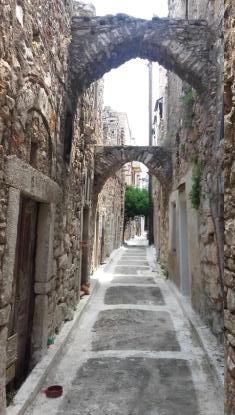
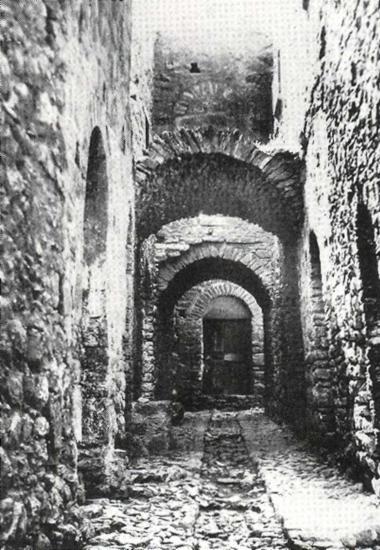
Put the phone away between stops. There is plenty to notice above the lanes.
Start and finish outside Platsa café in the centre. Visit Pano Panagia, Kato Panagia, Saint Konstantinos, Agia Kyriaki and Agia Paraskevi in that order. The 970 m street loop visits each church once without repeating a mapped street section. Short entrance approaches are additional; follow the numbered map and confirm public access locally.
No loop fits both choices. Allow more time for the countryside, or choose a shorter village circuit.
Times are planning estimates, not a walking pace guarantee. Filters use the upper end of each time range. Uneven paving, steps and road traffic may affect your choice; these routes are not assessed for step-free access.
YOUR ROUTE, HERE IN THE GUIDE
See the whole circle.
Choose a loop and open walking view. Each village stop has a story to explore; follow its reading links and return to the same stop on your map. Mark visits only when you arrive.
Map + stops on one screen · manual progress, no live location
Loading the village map…
↑ N
Full loopWalking leg✓Visited
Choose a stop to preview it. Your visits change only when you mark an arrival.
Route conditions
At this stop · story & details
Solid lines follow mapped streets; dotted links connect the reference pins to the nearest mapped road. This is an orientation map, not live GPS or turn-by-turn navigation. Offset number labels use a small line to their map point. Some entrances and short approaches need local confirmation.
Start and finish outside Platsa café in the centre. Visit Pano Panagia, Kato Panagia, Saint Konstantinos, Agia Kyriaki and Agia Paraskevi in that order. The 970 m street loop visits each church once without repeating a mapped street section. Short entrance approaches are additional; follow the numbered map and confirm public access locally.
≈ 970 m · Allow 60–90 minutes with pauses
Distance rounded from mapped streets, 3 November 2026. Visit time is a planning estimate including pauses.
Meet in the public space outside the café. Use its map pin as your starting reference, then look at how doorways and stone passages fit together around you. No purchase is needed to follow the walk.
In the older settlement, houses did more than shelter separate households. Their outer walls formed a defensive edge, while rooms and arches spanned the lanes. Look at the space above the street as well as the façades: the connection between buildings is part of Kalamoti’s story.
Follow one arch with your eyes. Which walls does it bring together?
Begin with Pano Panagia, dedicated to the Dormition of the Virgin. Later in this loop you will meet Kato Panagia, whose dedication is different. Notice how this church sits within the compact village fabric.
A story to take with you +
KALAMOTI, A LITTLE CLOSER
Two churches, two dedications
The village archive records Pano Panagia among Kalamoti’s former parish churches and identifies its dedication as the Dormition. Kato Panagia, later on this circuit, is dedicated to the Presentation of the Virgin. Knowing the names helps you keep the two places and their stories distinct.
Remember one detail of the entrance to compare with Kato Panagia later.
Kato Panagia is dedicated to the Presentation of the Virgin. View the church from outside and notice its place among the houses. Ask locally about entry if you would like to see the interior.
A story to take with you +
KALAMOTI, A LITTLE CLOSER
The village beyond its stone walls
Kato Panagia is dedicated to the Presentation of the Virgin; the Chios guide highlights its carved wooden iconostasis. The exterior gives you one part of the story. If entry is possible, the interior offers another way to look at craftsmanship and worship within the village.
Notice how the church entrance meets the lane. Ask locally before planning an interior visit.
Pause by the church and look up at its bell tower. Continue through the public lanes, noticing how the buildings share a compact space. The walk does not depend on the church being open.
A story to take with you +
KALAMOTI, A LITTLE CLOSER
A landmark above the lanes
The Chios guide singles out Saint Konstantinos for its bell tower. Look at the tower from the lane, then at the neighbouring roofs. The changing view invites you to experience the church as part of the settlement, even when its doors are closed.
Take a few steps along the public lane. What appears or disappears from view?
This church connects the walk with Kalamoti’s July religious celebrations. Pause outside and read its story, then follow the western return towards Agia Paraskevi. Services take priority over sightseeing.
A story to take with you +
KALAMOTI, A LITTLE CLOSER
The care behind a church
Agia Kyriaki appears among the former parish churches in the village archive. The same account describes the work of parish trustees: caring for buildings and furnishings, managing resources and organising celebrations. A church’s story includes that everyday shared responsibility as well as its architecture.
What work would be needed to keep a place like this ready for a celebration?
A final church stop close to the centre. Pause outside, then follow the short return to Platsa. The feast day belongs to the village’s religious calendar; access today depends on local arrangements.
A story to take with you +
KALAMOTI, A LITTLE CLOSER
A church at the centre of community life
The local archive identifies Agia Paraskevi as the village church from 1681. That date describes its community role; it does not date every wall you see today. End the church circuit with this distinction in mind: a place’s long history includes changing buildings and continuing relationships.
Look back towards the lanes before returning to Platsa. How does the church connect with the neighbourhood?
Close the loop at the same place you started. Mark this final step only when you have returned.
A story to take with you +
KALAMOTI, A LITTLE CLOSER
The same square, a different view
Before leaving Platsa, choose one detail you did not notice at the start. An arch, a doorway, a church or a memorial can become the beginning of your own village story. Give that discovery a little more time: read a resident’s account, or stay for a coffee in the village.
What would you point out to someone visiting Kalamoti for the first time?
Reference pins checked against Google Maps and OpenStreetMap on 3 November 2026. The start uses Platsa café’s pin; the memorial uses the neighbouring school’s pin. These identify landmarks, not guaranteed accessible entrances.